…Former SGF Accuses ADC Of Favouring Ex-VP In Primaries
…Atiku Dismisses Claims, Says Critic Driven By Bitterness
By Steve Kolade
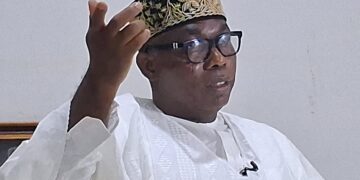
A fresh political war of words has erupted between former Vice-President Atiku Abubakar and former Secretary to the Government of the Federation (SGF), Babachir David Lawal, over the 2027 presidential election and leadership of the African Democratic Congress (ADC).
The latest exchange followed Lawal’s renewed criticism of Atiku’s presidential ambition and his allegations that the ADC’s internal processes were manipulated in favour of the former vice-president.
Lawal, who recently resigned from the ADC, had accused the party of conducting primaries that were allegedly skewed to favour Atiku and his political associates.
The former SGF further argued that Atiku lacks the political capacity to defeat President Bola Tinubu in the 2027 presidential election, insisting that the opposition party should consider presenting an alternative candidate.
In a Facebook post on Saturday, Lawal defended his earlier remarks, saying critics had concentrated on attacking his personality rather than addressing the issues he raised.
He maintained that his comments were being deliberately misrepresented as an attack on a particular ethnic group, stressing that discussions about presidential aspirants should focus on competence, leadership qualities and public records.
“Criticism of political leaders should not be viewed through an ethnic lens,” Lawal stated, adding that Nigerians have a right to scrutinise those seeking the nation’s highest office.
The former SGF also revisited the circumstances surrounding his removal from office during the administration of former President Muhammadu Buhari.
Lawal claimed that his exit from government was politically orchestrated by individuals who were uncomfortable with his close relationship with Buhari and allegedly feared he was being groomed for a higher political role.
According to him, some northern political figures and lawmakers allegedly coordinated efforts that eventually led to his removal from office.
He insisted that allegations linked to the contract scandal that resulted in his dismissal were not substantiated, noting that investigations by the Economic and Financial Crimes Commission (EFCC) and subsequent court proceedings cleared him of wrongdoing.
“During the trial, EFCC called 14 witnesses. Interestingly, all of them testified to my innocence as if they were my own witnesses,” Lawal said.
Responding on Sunday through his Senior Special Assistant on Public Communication, Phrank Shaibu, Atiku accused Lawal of engaging in divisive rhetoric and promoting ethnic stereotypes.
The former vice-president described Lawal’s comments as unfortunate and unbecoming of a statesman, alleging that they lacked evidence and were aimed at discrediting a political opponent.
According to Atiku, the most troubling aspect of Lawal’s intervention was what he described as an attempt to associate an entire ethnic group with the actions of a few criminal elements.
“It is both dangerous and irresponsible to suggest that any Nigerian should be judged or condemned simply because they share a common ancestry with individuals who commit crimes,” Atiku said.
The former vice-president also pointed out what he described as contradictions in Lawal’s recent public statements, noting that the former SGF had simultaneously claimed political victimhood while boasting about his relevance and influence within the political space.
Atiku recalled that Lawal served under former President Muhammadu Buhari, a Fulani leader, and accepted the trust and responsibilities that accompanied his appointment as SGF.
He questioned why Lawal would now seek to portray another Fulani politician’s presidential ambition as an ethnic project.
Defending his record, Atiku rejected claims that he had been indifferent to victims of insecurity, citing his visits to affected communities and educational support provided to some of the released Chibok schoolgirls through scholarships at the American University of Nigeria.
He also highlighted his investments in education and business, arguing that his contributions to national development demonstrated his competence and commitment to Nigeria’s progress.
Atiku said the tone of Lawal’s recent comments reflected personal resentment rather than objective political criticism.
“His heart appears full of bitterness and his public utterances increasingly reflect anger rather than reason, grievance rather than evidence,” the former vice-president stated.
The exchange is the latest sign of growing tensions within opposition circles ahead of the 2027 general elections, with both camps seeking to shape the narrative around leadership, competence and the future direction of the country’s political landscape.