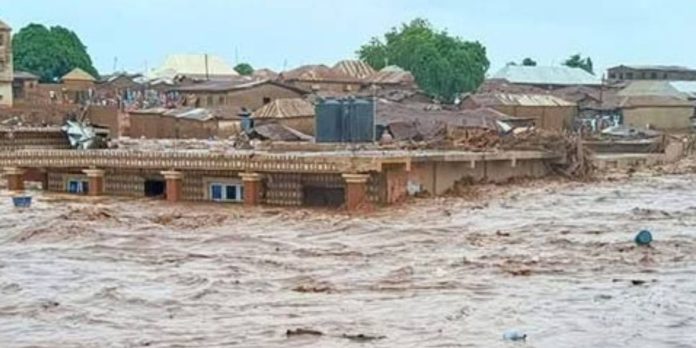
…Warns of flash floods in major cities
..Calls for urgent preparedness, improved drainage systems
The Federal Government has raised alarm over impending widespread flooding across Nigeria, disclosing that no fewer than 14,118 communities in 33 states and the Federal Capital Territory (FCT) are at high risk in 2026.
Minister of Water Resources and Sanitation, Joseph Utsev, made the disclosure on Wednesday in Abuja during the presentation of the 2026 Annual Flood Outlook (AFO) by the Nigeria Hydrological Services Agency.
According to him, the vulnerable communities are spread across 266 local government areas, based on scientific forecasts and detailed hydrological assessments.
States identified as high-risk include Anambra, Lagos, Kano, Bayelsa, Delta, Rivers, Ogun, Kaduna, Kogi, Benue, Niger, among others, alongside the FCT.
Utsev further revealed that 15,597 communities in 405 LGAs across 35 states fall within the moderate flood risk category, while 923 communities in 77 LGAs across 24 states are classified as low-risk areas. He noted that Ekiti is the only state not captured in any of the risk categories.
The minister warned of possible flash and urban flooding in major cities such as Abuja, Lagos, Port Harcourt, Ibadan and Kano, citing increased vulnerability due to rapid urbanisation and poor drainage infrastructure.
He also highlighted the likelihood of coastal and riverine flooding in states like Bayelsa, Cross River, Delta, Lagos, Ogun, Rivers and Ondo, attributing the threat to rising sea levels and tidal surges.
Describing the flood outlook as more than a routine report, Utsev stressed that it serves as a critical early warning tool capable of saving lives and reducing economic losses if properly utilised.
He linked the growing frequency of flooding incidents to climate variability, unregulated urban expansion, inadequate drainage systems and poor land-use practices.
To mitigate the risks, the minister said the government is strengthening hydrological monitoring through improved data systems, automated river gauges and advanced modelling technologies.
He added that collaboration with the Nigerian Meteorological Agency and the National Emergency Management Agency is being enhanced to improve forecast accuracy and early warning dissemination.
Utsev urged state governments to incorporate flood risk considerations into urban planning and infrastructure development, while also investing in drainage improvements and community-level preparedness.
Speaking at the event, President Bola Tinubu, represented by the Minister of Environment, Balarabe Lawal, described flooding as a persistent national challenge.
He noted that recurring incidents since the 2012 Nigeria floods underscore the need for proactive and coordinated responses.
The president said ongoing flood control projects and policy interventions by his administration are aimed at reducing the impact of such disasters, adding that the 2024 Maiduguri flood marked a turning point toward anticipatory disaster management.
Tinubu emphasised that the Annual Flood Outlook remains a vital planning tool for early action, mitigation and evacuation strategies, urging stakeholders to leverage the report to safeguard lives, livelihoods and infrastructure.
Director-General of NIHSA, Umar Mohammed, said the 2026 forecast is based on comprehensive, data-driven analysis of flood-prone areas across the country.
He added that the agency has upgraded its forecasting system to an AI-integrated model, enhancing accuracy and improving response time, while its flood dashboard now supports real-time monitoring and alerts.
Mohammed called on residents in vulnerable communities to take early warnings seriously and adopt preventive measures, stressing that collective preparedness remains key to reducing the devastating impact of flooding nationwide.