
Don urges law lecturers to embrace clinical legal education
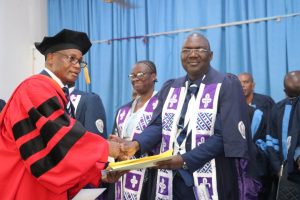
A Professor of Law, Charles Adekoya, has urged law lecturers and legal educators in the Nigerian universities to embrace clinical legal education towards producing justice-oriented graduates to bridge the huge gap in the administration of civil justice in the country.
Adekoya, who is also the Deputy Vice-Chancellor, Administration, Olabisi Onabanjo University (OOU), Ago-Iwoye, equally challenged the Bar and the Bench to make concerted efforts in removing all the impediments militating against the administration of justice in Nigeria.
He made the call while delivering the 103rd OOU Inaugural Lecture on Tuesday, 13th December, 2022 at the Otunba Gbenga Daniel Lecture Theatre, Main Campus of the University, Ago-Iwoye.
The Lecture entitled, “Betrayal of the Poor in Accessing Justice in Nigeria: The Judas in our Midst,” was chaired by the Vice-Chancellor of the University, Prof. Ayodeji Agboola, and graced by eminent personalities within and beyond the legal profession.
At the event, Prof. Adekoya lamented the humongous challenges in accessing justice in Nigeria, especially by the poor, and warned that lack of access to justice could force the disadvantaged members of the society to resort to violence similar to the EndSARS protest.
“It seems we have lost empathy for the poor and have left them to their fate through our nonchalance to the abuses and debasement of their rights, but the question is: can we stand the forced and aggressive voice of the poor if raised against the society when they break loose from a prolonged gag?,” he opined.
The don, therefore, canvassed the reforming of the nation’s justice system to make judicial proceedings generally simple, speedy and inexpensive as well as increase in funding for legal aid for the sake of the poor.
Making a case for clinical legal education, the Inaugural Lecturer said legal training had hitherto not been justice-centred but done mainly through the traditional method of instruction which placed emphasis on legalism without attention to values and justice.
“Thus, the production of graduates by Law Faculties, who provide access to justice for the poor are in short supply as a result of lack of justice-oriented training,” he submitted. “For this reason, lawyers have gained notoriety and are called derogatory names for their seeming indifference to the plight of the poor and disadvantaged members of the society.”
Adekoya further said, “Legal educators are therefore deemed culpable for not exposing students to social justice issues and for failing to lay emphasis on skills and strict ethical values which would have shaped our products that find their ways to the Bench and the Bar. This makes the graduates ill-equipped to practise the profession. This is the reason why many of the products contribute significantly to the suffocation of the administration of the civil justice system in Nigeria.
“As a result of the deficits in the legal educational system, students are not being exposed to social justice issues in the society in order to prepare them as advocate for justice, thus provoking the public lawyering spirits in them. This has contributed to the increased justice gap in Nigeria and as a result of the failure of members of the legal profession to bridge this gap, in spite of the fact that many new lawyers are admitted to the Bar each year.”
The scholar recalled that as a result of the dysfunctional training, a non-governmental organisation promoting clinical legal education, Network of University Legal Aid Institutions (NULAI-Nigeria), spearheaded reform in legal education by introducing Clinical Legal Education into Law Faculties and Law Schools.
“Law students now undergo experimental learning through the law clinics geared towards legal service delivery, thus energising the vocational training of law as a great tool for promoting justice, especially for the poor. Faculty-based Law Clinics have since been involved in the promotion of human rights and the expansion of access to justice,” he added.
Prof. Adekoya noted that judicial officers and lawyers are products of legal training and critical stakeholders in the administration of civil justice, stressing that the way they are trained matters a lot in meeting professional calling and societal expectations.
He, however, expressed dissatisfaction at the “apathy on the part of old colleagues to embrace change” as well as “the low level of participation by law students in clinical activities.”
He said, “Lack of commitment to the clinical trainings and a relapse into the traditional methods of training are constituting great hindrance. Other obstacles confronting clinical education are standardisation in terms of law clinics and moot courts and lip service by faculty members and students.
“There is therefore the need for Council of Legal Education (CLE) to be fully integrated into the curriculum of faculties of law in order to ensure commitment of both faculty members and students in terms of effective implementation, adequate supervision and dedication to clinical activities.”
The Deputy Vice-Chancellor also advocated the change in nomenclature of the place of training lawyers from the existing Faculty of Law to either ‘Faculty of Justice’ or ‘Faculty of Law and Justice’ to bring the consciousness of justice to students.
“This is the practice in some other climes, in order to activate the consciousness of justice in legal training. It might be worthwhile to reconsider having a Faculty of Law simpli citer without justice. Faculties of Law need to get the objective of legal education right by educating for justice and not for law per se in order to narrow the civil justice gap for the poor,” he submitted.