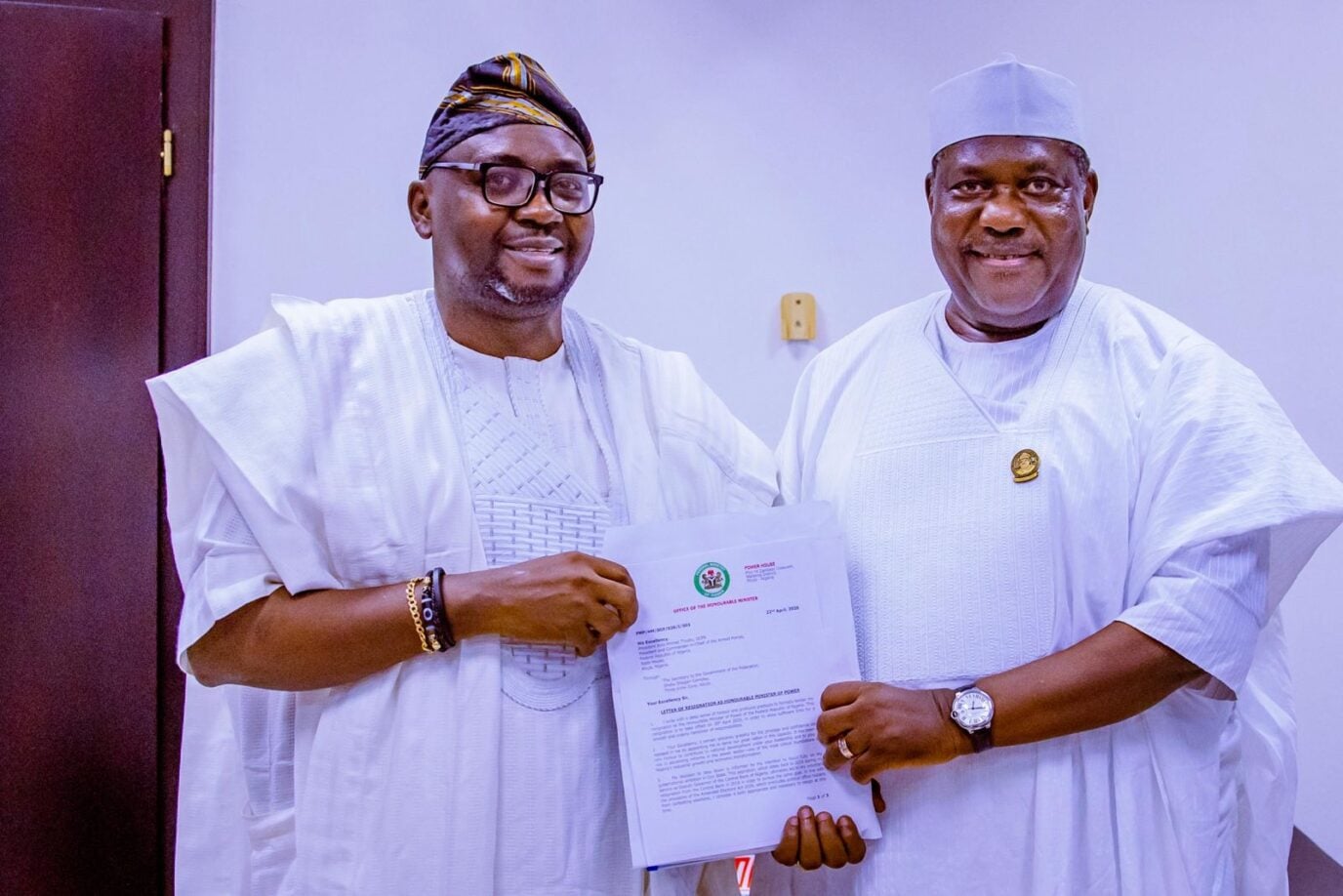
Adebayo Adelabu, immediate former minister of power, on Wednesday posed with his resignation letter alongside George Akume, secretary to the government of the federation (SGF), shortly after exiting President Bola Tinubu’s cabinet.
The picture, which surfaced shortly after the minister announced his resignation, shows him and Akume jointly holding the document following his visit to the SGF’s office to formally submit the letter.
The resignation would take effect on April 30.
Tinubu appointed Adelabu as minister of power in August 2023, following his confirmation by the senate.
Giving reasons for his resignation, the former minister said he was quitting the cabinet to enable him to focus on his governorship ambition in Oyo state.
In the letter dated April 22 and addressed to the president, Adelabu proposed the creation of a coordinating minister for energy to drive integrated reforms across Nigeria’s electricity and gas sectors.
Earlier on Wednesday, Tunji Bolaji, his special adviser on strategic communications and media relations, hinted at the impending resignation.
Bolaji said Adelabu intimated Tinubu of his impending resignation during a meeting on Tuesday, with the president handing the minister his blessings.
At a press conference on March 24, Adelabu declined to comment on his resignation or governorship ambition, saying he remained focused on addressing the country’s electricity challenges.
However, in the letter, he said his decision aligns with the provisions of the amended Electoral Act.
Bolaji added that the minister expressed appreciation to the president for the opportunity to serve.
“My decision to step down is guided by my desire to fully comply with the provisions of the Electoral Act and to focus on my governorship aspiration in Oyo State,” Adelabu was quoted as saying.
The spokesperson added that the former minister emphasised the need for stronger coordination across the energy sector to sustain ongoing reforms.
“Sustaining and consolidating the gains recorded in the power sector requires stronger coordination at the highest level, including the appointment of a central authority to harmonise policy direction and execution,” he said.