...Said govt didn’t take its May 1 ultimatum serious
..Regrets inconveniences strike may cause Nigerians
…OPS kicks, threatens action
…..Minimum Wage negotiations deadlocked again
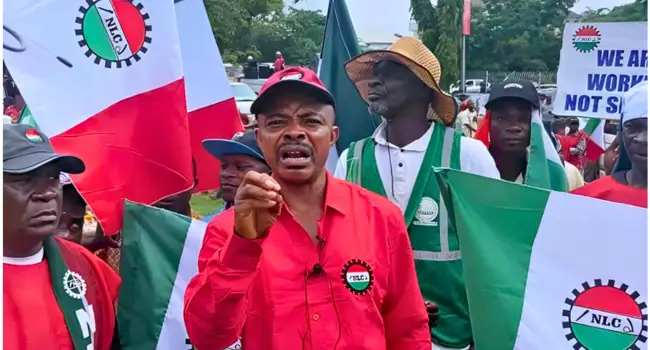
The Nigeria Labour Congress (NLC) and Trade Union Congress (TUC) have declared a nationwide strike beginning from Monday, June 3rd, 2024 over the tripartite committee’s inability to agree on a new minimum wage and hike in electricity tariff.
The President of the TUC Festus Osifo announced the strike at a joint news conference with the leadership of the NLC in Abuja on Friday.
According to the labour leaders, the decision follows the expiration of an earlier request to the Federal Government to conclude all negotiations for a new minimum wage before the end of May.
“In light of this persistent inaction, we, the Nigeria Labour Congress (NLC) and the Trade Union Congress (TUC), hereby issue a notice of commencement of an indefinite nationwide strike to the Federal Government,” Osifo said.
“We reiterate that since the National Minimum Wage negotiation exercise has not been concluded and the agreed wage passed into law; the hike in electricity tariff has not been reversed and the categorization of consumers into Bands has not stopped as demanded; Nigerian workers are compelled by these failures to embark on an indefinite nationwide industrial action beginning on Monday, the 3rd of June, 2024 to press home our demands.”
The organised labour had once pulled out of the negotiation and rejected two Federal Government offers, the latest being N60,000. They are insisting on N497,000 as minimum wage.
Rising Living Cost
Since the removal of fuel subsidy and the floating of the naira, the cost of living in Nigeria has reached new highs, heightening calls for a new minimum wage.
In the wake of the development, labour leaders have reeled out several measures including a new minimum wage, alternative modes of transportation, and others to cushion the impact of the subsidy removal.
The government later set up a committee made up of labour leaders, government officials, and the organised private sector to negotiate a new minimum wage.
Despite several meetings, the committee failed to reach a consensus, prompting the recent strike action by the labour leaders. The Federal Government is yet to comment on the TUC and NLC’s latest move.
Minimum Wage negotiations deadlocked again
Meanwhile, talks to reach a compromise on a new minimum wage for workers in the public service have been deadlocked as organised Labour, again walked out of the meeting.
Sources attending the meeting said the government failed to propose an amount higher than the N60,000 it earlier offered when the parties met on Tuesday this week.
With the latest development, there are strong indications that the Nigeria Labour Congress and Trade Union Congress may begin to mobilise for a strike as they have scheduled a press conference by 4pm at the national headquarters.
OPS fumes
Meanwhile, the Organised Private Sector, OPS, has condemned the decision by organised labour to begin an indefinite strike from Monday. Spokesperson for OPS, who doubles as the Director- General of the Nigeria Employers’ Consultative Association, NECA, Wale Smatt-Oyerinde, warned that “Organized Businesses will also, within extant legislation do all that is necessary to protect enterprise sustainability and protect jobs.”
In a statement, he said “Following the third walkout by Organized Labour during the National Minimum Wage Negotiation Committee meeting, the Organized Private Sector of Nigeria, comprising Nigeria Employers’ Consultative Association (NECA), Manufacturers’ Association of Nigeria (MAN), National Association of Chambers of Commerce, Industries, Mines and Agriculture (NACCIMA), National Association of Small Scale Industries (NASME) and National Association of Small Scale Industrialists (NASSI) expressed its concern as the National Minimum Wage Committee, after its 7th meeting, could not achieve a consensus.
“The Organized Private Sector of Nigeria (OPSN) had approached the Minimum Wage negotiation hoping that current economic realities as it concerns the need to protect jobs and ensure sustained growth would play a paramount role. However, this was not the case. The Committee was set up to negotiate a new National Minimum Wage and not a living wage. Neither was it inaugurated to adjust salaries. The Minimum Wage is the wage that no employer should pay below, either in the private or public sector.
“Our position was informed by the need to arrest the ongoing job losses and continuous shut-down of businesses in Nigeria. It is important to state that jobs can only be guaranteed when businesses are alive and sustainable.
While it is within the right of Organized Labour to embark on any action it deems fit and necessary to achieve its objectives, Organized Businesses will also, within extant legislation do all that is necessary to protect enterprise sustainability and protect jobs.
“It is no secret that organized businesses are currently faced with multidimensional challenges ranging from multiple taxes, levies and fees, recent astronomical power costs, rising interest rates and exchange rates amongst many others