..Seven migrants died during month-long desert journey
…Returnee warns youths against deceptive migration promises
By Anthony Oboh
A 23-year-old Nigerian woman recently repatriated from Libya has shared a harrowing account of survival, exploitation and loss during her journey through the Sahara Desert, warning young Nigerians against falling victim to false promises of better opportunities abroad.
The returnee, Endurance Daniel, narrated her experience on Wednesday following her arrival in Nigeria as part of a group of 182 migrants assisted home by the International Organization for Migration (IOM).
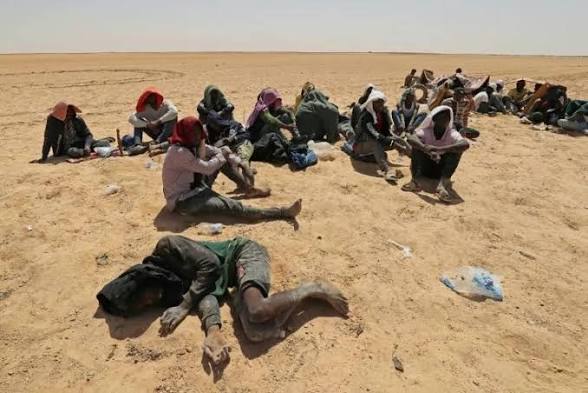
Speaking in an interview with the News Agency of Nigeria (NAN), Daniel revealed that she and dozens of other migrants were forced to drink their own urine to stay alive after running out of water during a month-long trek through the desert.
According to her, she travelled in a vehicle carrying 53 migrants, including herself, and endured extreme hardship that claimed the lives of seven passengers before they reached their destination.
“We spent more than a month in the desert without water. We had no choice but to drink our urine to survive. At some point, some of us could no longer urinate because of severe dehydration, while others passed blood instead,” she said.
Daniel recalled watching fellow travellers die under the harsh conditions, adding that their bodies remained in the desert for days because there was no means of giving them proper burials.
She said she was only 17 years old when she was persuaded to leave Nigeria by a family acquaintance who painted Libya as a land of opportunity where young people could quickly earn money and improve their living conditions.
According to her, the woman assured her family that she would secure employment, repay her sponsor within a short period and eventually establish her own business.
Driven by poverty and the difficult circumstances facing her family at the time, Daniel said she accepted the offer and embarked on the journey in 2019.
However, upon arriving in Libya, she discovered that the promises made to her were far from reality.
She alleged that her sponsor informed her that the only available jobs for female migrants were domestic work and prostitution.
Daniel said she immediately sought a way to return home but was prevented from doing so by traffickers who insisted she must first repay the cost of her transportation.
She further claimed that she was denied access to communication with her family because traffickers feared her relatives might send money to facilitate her return to Nigeria.
The returnee described an environment of intimidation and coercion where migrants were routinely threatened and manipulated.
According to her, traffickers warned that anyone who refused to obey instructions could be sold into prostitution or subjected to other forms of exploitation.
“They used fear to control us. We were told terrible things would happen if we refused to cooperate,” she recounted.
Daniel also revealed that promises of allowing migrants to contact their families were often used as a bargaining tool to force compliance.
Describing the desert crossing as one of the most traumatic experiences of her life, she said migrants faced severe hunger, thirst and exhaustion while struggling to survive in unforgiving conditions.
She added that after leaving the desert, survivors were housed in camps where food was scarce and living conditions remained deplorable.
According to her, migrants were often fed plain spaghetti without salt or any form of accompaniment.
“We ate whatever was available because we had no alternative,” she said.
Daniel further disclosed that migrants were frequently concealed in vehicles and transported secretly to avoid arrest by security agencies and immigration authorities.
She noted that being discovered during inspections often resulted in detention and imprisonment, making the journey even more dangerous.
Despite the years of hardship and exploitation she endured, Daniel expressed gratitude for the opportunity to return home safely.
She commended the efforts of humanitarian organisations and authorities involved in facilitating the return of stranded Nigerians from Libya.
The returnee urged young Nigerians considering irregular migration to thoroughly investigate opportunities abroad before making life-changing decisions.
She warned that many of the promises made by traffickers and illegal migration agents are deceptive and designed to lure vulnerable individuals into exploitation.
Daniel stressed that the reality of irregular migration often differs drastically from the attractive stories used to recruit desperate youths.
Her testimony adds to growing concerns over human trafficking and irregular migration routes across North Africa, which continue to expose thousands of Africans to abuse, exploitation and death.
Stakeholders have repeatedly called for stronger public awareness campaigns, improved economic opportunities for young people and tougher action against human trafficking networks operating across the continent.
As Nigeria continues efforts to repatriate citizens stranded abroad, Daniel’s story serves as a sobering reminder of the dangers associated with irregular migration and the human cost of seeking opportunities through unsafe channels.